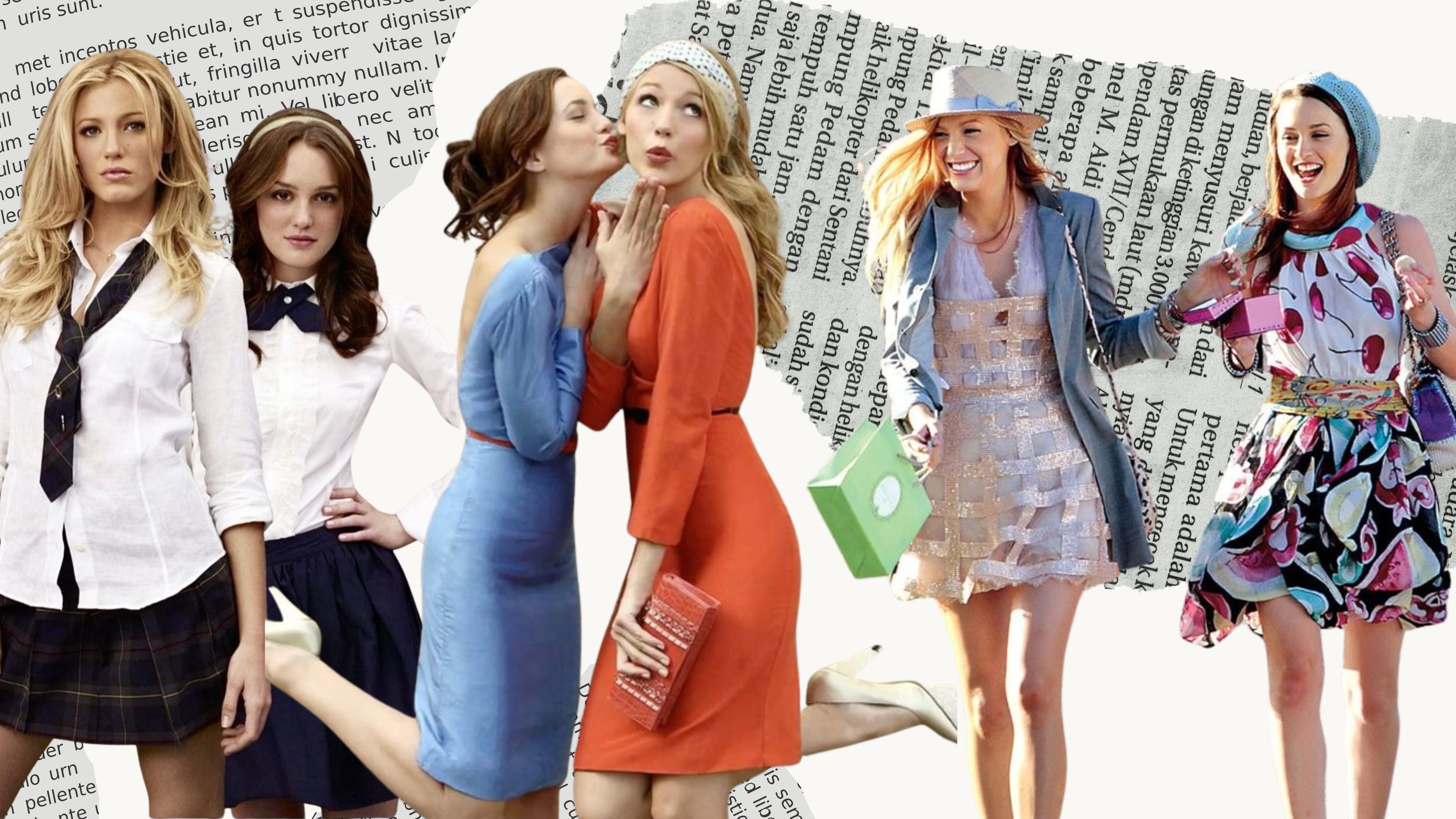
They may do besties better than anyone, but they also do fashion better than anyone… With the steps of the Met as their runway, and designer collections beyond our wildest dreams, Serena Van der Woodsen and Blair Waldorf ruled not only the Upper East Side, but the fashion world. All things glamour and luxury met New York City and teenage rebellion to create an ultrarecognizable time capsule of fashion influence. Beyond a cultural phenomenon emblazoned in millennial history forever, Gossip Girl used style as a mirror into Serena and Blair’s characters. Their clothing choices were like diary entries. Every hemline, fabric choice, and designer label was so much more– unraveling Serena’s search for freedom and Blair’s ambitions of perfection.

Spotted at Grand Central Station…Serena Van der Woodsen. An iconic intro for an iconic character. Messy and naive, yet lovable and sunshiney. Serena is one of those characters you find yourself rooting for even after watching her make the same mistakes over and over. She is constantly in search of something, whether that be a man, a career, or a purpose. Even as the proclaimed “it girl” of the Upper East Side, she fears irrelevancy and is constantly pulling stunts that put her back at the center of attention. She resets over and over, desperately trying to escape the circle of gossip and rumors and secrecy that the Upper East Side hosts, but is drawn back in time and time again. So, how does Serena’s boho-chic, effortless, yet seamlessly sequined style show the struggles of a girl with good intentions, but often poor execution?
Serena’s style is anything but minimal. She frequently uses bold colors and statement accessories that make an impression. One of her greatest fears was being deemed “irrelevant” after the Gossip Girl blast at graduation pinned her as such. Serena loves attention and making a statement, as seen when she runs away for the summer (a seemingly common occurrence…) to try to attract her long-absent father by participating in wild activities to attract as much paparazzi as possible. Despite her efforts to get away, she is constantly drawn back to the affluent Upper East Side, where she can be the “golden sun”. Serena is painted as a “reformed angel,” and through the motif of gold in her wardrobe, which symbolizes grandeur, wealth, and success, she is seen as desirable, yet almost unattainable. Sought after. Which is exactly what Serena wants to be.

Serena’s style radiates the same magnetic spontaneity that defines her character. Flowing fabrics, loose silhouettes, and sun-kissed hues that capture her carefree spirit and her golden girl reputation. Yet, beneath that glow lies her restlessness. She wears hair scarves and flowy dresses, but also sharp blazers and designer gowns. This dichotomy between styles reflects her dual nature. She is a free spirit– a go with the flow kind of girl with a wild side, but she lives in a highly structured, wealthy environment full of expectations. As seen in the iterations of her school uniform, she looks effortlessly thrown together with an undone tie and t-shirt, but still glamorous with designer accessories. Serena constantly blends high-fashion luxury items with casual items, furthering the display of this dichotomy. She loves the wealth and the glamour her family and upbringing give her, but she knows that there is more to life than that suffocating circle and longs to discover herself and the world beyond the Upper East Side. Bohemian touches like her layers of jewelry, unbuttoned blouses, and tousled hair suggest this desire to escape the rigidity of the privileged world she lives in. Serena dresses as if she is always in motion. Never grounded anywhere or with anyone, demonstrating the turbulence she experiences internally and her inability to stay put in New York. Her wardrobe blurs the lines between vulnerability and rebellion. It is both freedom and a disguise. A sort of ease that conceals the chaos within.

Blair Waldorf will always be the queen of Constance, but she is also the queen of a perfectly styled look. She once told Dan Humphrey, “Fashion is the most powerful art there is. It’s movement, design, and architecture all in one. It shows the world who we are and who we’d like to be”. This statement could not be more true, especially for Blair herself. Blair’s style is defined by her perfectly tailored, immaculately accessorized, classically polished, and feminine look– all elements which reflect her devotion to order, tradition, and dominance within her social hierarchy. Her style is a mirror reflection of her high-class private school environment. She uses clothing to project power and emanate her status as Queen B through crownlike headbands and regal blouses. Her look is meticulously planned with the image of perfection, which is exactly how Blair wants to be seen. She longs to be a “powerful woman,” and her controlled high-fashion choices reinforce her ambitions. The tailored control in Blair’s wardrobe is like armor. It shows the world who she would like to be, while hiding some of who she really is…
Yet, her curated image of elegance hides her deep insecurities that she will never become the woman she aspires to be. What if imperfection unravels her carefully built and perfectly polished exterior? Blair frequently references Audrey Hepburn, tying herself to classic Hollywood glamor and her self-image of becoming an icon. She wants to be in control, but Blair is easily threatened and driven by her emotional impulses. She conflates her self-worth in comparison to Serena or in response to the attention of the men in her life. She struggles with familial issues due to her often absent mother and distant father, and with her self-image as she is seen struggling with an eating disorder. All of these things don’t fit the perception that Blair wants to uphold. She wants to be seen as completely in control of herself and her emotions, powerful, intelligent, and ruthlessly ambitious.

Her look of sophistication also hides her more immature scheming tendencies, often referred to as “the dark side” of Blair, but one that she can never quite shake. When Blair’s life begins to crack, her wardrobe shifts subtly to darker tones, sharper lines, and bolder statements, which reveal a growing internal conflict between who she is and who she thinks she must be. Blair knows that to achieve her goals, she must lose these “darker” ways, and she tries to use fashion to cover these tendencies up. Yet, ruffles, bows, and lace can only hide so much as she continues to scheme behind the scenes and hurt others, while still striving for the “perfect” life and to be the “perfect” Blair.
Despite her love for a good, potentially morally compromising scheme, Blair also has a softer and more compassionate side defined by her fierce and undying loyalty to her loved ones. Blair is not one to give up on someone she loves (enter Chuck Bass) or her dreams. This side of her is reflected in the traditional femininity seen in her wardrobe. Seeing Blair in florals, girly headbands, pastels, soft curls, and ruffly dresses gives Blair a softer aura than her traditionally more sharp, contrasting, detailed looks, and often comes when Blair is more secure in herself and her relationships. Her couture is woven with ambition and insecurity in equal measure. For Blair, fashion is not frivolous, but a constant negotiation between vulnerability and control.

This pair of besties’ fashion tells us what words can’t… Gossip Girl fashion operates as a psychological language. A language that Serena and Blair use to navigate identity, control, and self-worth. Through their wardrobes, we see not just two opposing aesthetics but two complex inner lives in motion, reminding us that style is never just surface, but a story. In a world obsessed with image, Gossip Girl turned fashion into confession, proving that the right outfit can both reveal and disguise our truest selves…
xoxo, S